
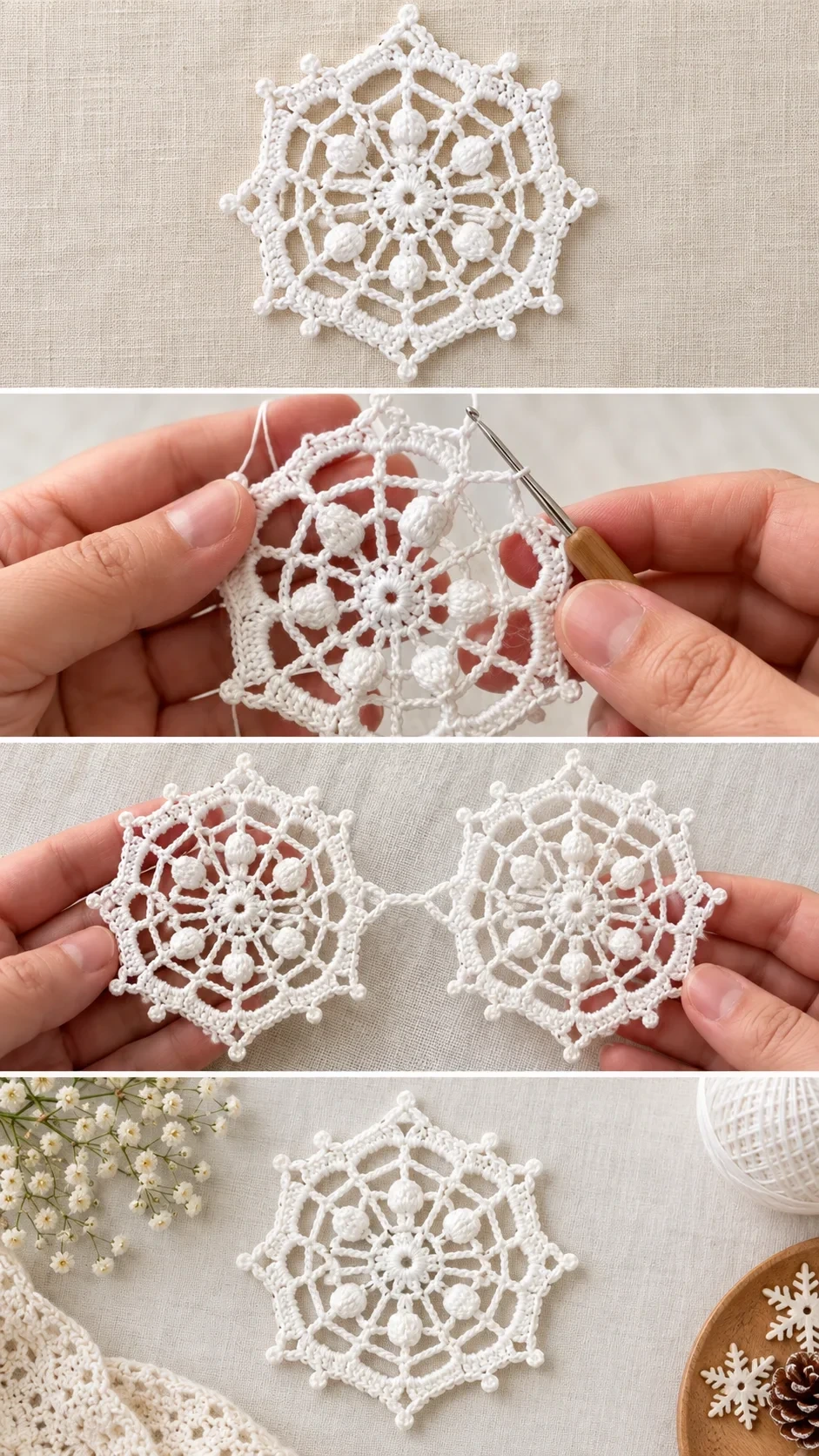
Some crochet projects are useful, and some are simply beautiful — this little snowflake is proudly the second kind. Worked in fine cotton thread, it grows from a tiny center ring into a lacy circle of spokes, bobbles, and pointed picot tips that looks like frost caught mid-fall. It is a quiet, focused make: one hook, one strand of thread, and round after round of lace building on itself until a perfect six-pointed flake sits in your palm.
What you’ll need
- Fingering weight or thread weight cotton yarn with a tight, smooth twist — white is the classic choice, but silver-grey, pale blue, or the softest blush pink all work beautifully
- Steel crochet hook, 1.5–2 mm (go up to 2.5 mm if you are using fine fingering weight and prefer a softer drape)
- Small embroidery scissors
- Blunt tapestry needle for weaving in ends
- Foam blocking mat and rust-proof pins — blocking is not optional for this one
Cotton matters here more than in most projects: it blocks willingly, and blocking is the step that turns a slightly ruffled little circle into a flat, crisp, geometric snowflake.
Crochet Snowflake
 Save
1. Delicate Lace Snowflake
Everything starts at the center. The snowflake is worked entirely in the round from a small magic ring (a tight chain loop works too), expanding outward in a radial structure — no seams, no pieces to join, nothing to assemble at the end. The early rounds build the core wheel with double crochet clusters and open chain spaces, the middle rounds add the raised bobble details that give the flake its sculptural, almost beaded texture, and the final rounds stretch into the pointed spokes finished with tiny picots.
The stitch palette is small but each stitch earns its place: chains form the airy mesh and spoke lines, single crochet anchors the chain spaces and keeps everything tight and controlled, double crochet builds the height and the open rings, bobbles puff up into those three-dimensional petal shapes, and picots finish every tip with a fine, frosty point. Once you settle into it, the rhythm becomes almost meditative — each round follows so naturally from the last that your hands learn what comes next.
Want to make it your own? Add an extra round of picots around the edge, or work a slightly longer chain between the spoke tips for a lacier, more elongated finish. As for using it: stitch one onto a winter coat lapel as a brooch, tie one onto a wrapped gift instead of a ribbon, hang several from satin ribbon as tree ornaments, or string a row of them into a garland across a mantel or window frame.
Video tutorial: HEARTWARMING Crochet Snowflake Pattern Tutorial — Crochet Knitting Therapy
Tip: block it properly and you will never go back. Soak the finished snowflake in cool water, squeeze out the excess gently without wringing, then pin it out to its full size on a blocking mat, stretching each point and pinning every picot into place. Let it dry completely — up to a full day — before unpinning.
Caring for your crochet snowflake
- Block after washing: If a snowflake needs freshening, soak it briefly in cool water with a little mild soap, rinse gently, and re-block it to its full shape so it dries crisp and flat.
- Store flat: Keep finished snowflakes layered between sheets of tissue paper in a box, out of direct sunlight, so both the shape and the bright white of the cotton last.
- Handle with care: The points and picots are the most delicate part — lift the snowflake from underneath rather than pulling it by a tip.
- Separate the whites: Store white thread pieces away from strongly colored yarns to avoid any color transfer over time.
The first blocked snowflake is a small revelation — it really does look like something nature made and you just happened to catch. Don’t be surprised if one turns into a whole windowsill of them by December. Happy crocheting!
